A mentor friend recently shared this meditation with us…and it has really been helping to ground us in these days when the world is burning all around us.
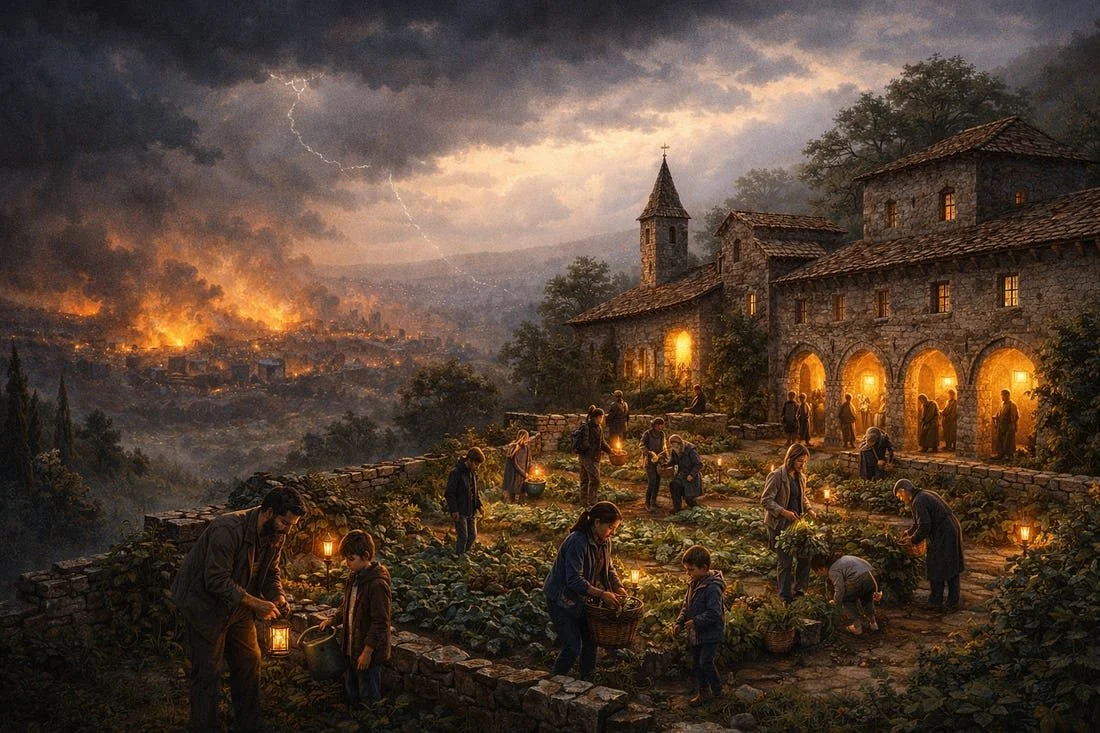
When the World Is Burning, Stay
A Meditation by Rev. Cameron Trimble
JAN 20, 2026
“Stability is not about standing still. It is about remaining faithful when everything else is in motion.” — adapted from the Rule of St. Benedict
The world does not feel steady right now. Institutions we were taught to trust are unraveling. Power is being abused without accountability. Fear is being used as a governing strategy. Many of us wake each day bracing ourselves for what new harm will be revealed.
We need to be honest about this. Naming the danger is not despair; it is sanity.
History tells us that moments like this are not new. Empires have fallen before. Moral orders have collapsed before. People have lived through seasons when cruelty was normalized and minorities were treated as a threat. In those moments, not everyone fled or fought. Some chose something less dramatic and more enduring.
In the sixth century, as the Roman Empire disintegrated, St. Benedict of Nursia did not try to save the empire. He also did not abandon the world. Instead, he gathered people into a way of life rooted in stability, shared labor, prayer, and care for the vulnerable. The monasteries that followed did not prevent collapse. But they preserved humanity within it.1
They became places where learning survived, where the poor were fed, where dignity was practiced when power had lost its moral compass. They did not do this by being loud or dominant. They did it by staying.
This is a different kind of courage than the kind we usually celebrate. It is the courage of remaining present when it would be easier to harden or disappear. It is the courage of tending life when destruction has momentum.
Benedict called this stability: committing to a place, a people, and a way of living that resists chaos without mirroring it. Stability is not passivity. It is disciplined faithfulness. It is the refusal to let fear decide who we become.
This matters for us now.
We are living through a time when many are tempted to withdraw, to numb themselves, or to believe that nothing they do will matter. But the Benedictine wisdom insists otherwise. It teaches that how we live in the midst of breakdown shapes what becomes possible afterward.
When we choose to stay human—when we keep telling the truth, caring for one another, protecting the vulnerable, practicing restraint instead of revenge—we become carriers of a different future, even if we never see its fullness.
This does not mean we ignore injustice or accept harm. Benedictine communities were not neutral. They were ordered around values that quietly but firmly contradicted domination: humility over power, shared resources over hoarding, hospitality over exclusion, care over control.
In times like these, courage does not always look like confrontation. Sometimes it looks like preserving what makes life worth saving.
If the world feels like it is burning, the invitation is not to match the fire with more fire. The invitation is to become places of shelter, memory, and moral clarity—to keep the human story alive until it can be told again more truthfully.
You are not weak for feeling afraid. You are not naïve for choosing tenderness. You are not irrelevant because you cannot fix everything.
The work now is to stay.
We are in this together,
Cameron